


Blog Details
The core question: When specifying an industrial barrier laminate, should you choose metallized PET (VMPET) or aluminum foil?
The short answer: For most industrial barrier needs — corrosion protection for metal parts, shielding for electronics, and insulation-facing layers — metallized PET film delivers the large majority of foil’s protection at roughly half the cost and a fraction of the weight, and it survives folding and transit far better. Reserve aluminum foil for the cases that truly demand unconditional, near-zero barrier: long storage, vacuum-sealed goods, or light-sensitive contents. The right call starts with your application’s real protection window and distribution profile, not with the shinier surface.
If you are specifying industrial barrier laminates and the recurring question is “metallized PET or aluminum foil?” — a classic PET lamination decision — the answer is never “the better material,” it is “the right barrier for this application, protection window, and budget.” A metallized PET film and an aluminum foil laminate both sit in the same specification conversations for industrial moisture barriers, equipment protective packaging, and insulation facings, but they behave very differently once the roll leaves the converter. This guide compares them on the variables that actually drive a buying decision — barrier performance, cost and weight, flex-cracking, chemical compatibility, and recyclability — and ends with a decision framework you can hand to procurement.
1. What Each Material Actually Is
1.1 Metallized PET Film (VMPET)
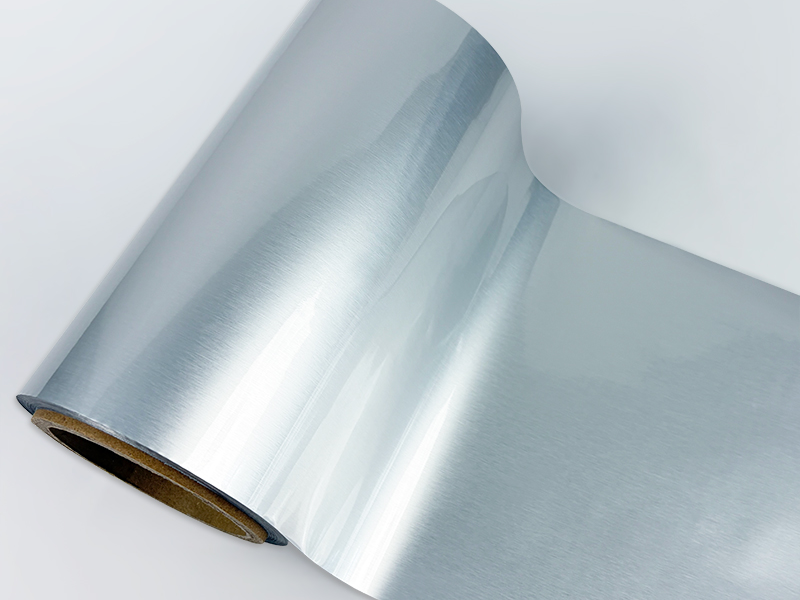
VMPET starts as a biaxially oriented PET film — typically 12 µm — that passes through a vacuum chamber where aluminum is vaporized and condensed onto the surface as an ultra-thin metallic layer, commonly in the range of about 30–50 nm. Because that deposited layer uses only a small fraction of the aluminum a solid-foil structure requires — often roughly 1% — it is the single biggest reason VMPET costs and weighs less. The PET base supplies strength, stiffness, printability, and heat resistance; the metal layer does the barrier work. Barrier performance scales with the deposit’s optical density (OD): a higher OD blocks more oxygen and light. Standard VMPET typically runs OD 1.8–2.3, while high-barrier grades push higher.

1.2 Aluminum Foil Laminate
An aluminum foil laminate bonds a solid sheet of aluminum — typically 6–9 µm for flexible industrial laminates — between polymer layers such as PET, PE, or PP. In a PET foil laminate, this continuous metal sheet is the core barrier. Because the metal is a solid, pinhole-free sheet when undamaged, it is effectively impermeable to oxygen, moisture, light, and aroma.
The structural difference drives every trade-off below: one is a plastic film coated with metal; the other is metal. That fact sits at the heart of the metallized PET vs aluminum foil comparison for any industrial buyer.
If your question is laminated foil vs plain (unlaminated) foil — rather than metallized PET vs foil — see our guide on laminated aluminum foil vs plain aluminum foil.
2. Barrier Performance Head-to-Head
The metrics that matter are Oxygen Transmission Rate (OTR) and Water Vapor Transmission Rate (WVTR), measured on the finished laminate. Typical specifications for the two structures from our own product range:
Finished laminate structure | Typical OTR | Typical WVTR | Light block |
|---|---|---|---|
PET / AL / PE (foil barrier) | ≤ 0.05 cm³/m²·day | ≤ 0.1 g/m²·day | 100% |
PET / VMPET / PE (metallized) | ≤ 1.0 cm³/m²·day | ≤ 0.5–1.0 g/m²·day | High (not total) |
In plain terms: a foil laminate is the gold standard — OTR and WVTR effectively at the floor. VMPET is roughly one to two orders of magnitude more permeable than foil, but for most industrial goods, electronic components, and metal parts that gap is irrelevant because the real protection requirement sits well within VMPET’s range. Engineers sometimes agonize for months over VMPET vs foil, only to find the component needed under a year of corrosion-free storage and VMPET covered it comfortably. The barrier difference is real, but it is rarely the deciding factor it appears to be.
3. Cost, Weight & Sustainability
This is where VMPET quietly wins for many supply chains. VMPET laminates are commonly quoted at roughly one-half to one-third the price of an equivalent foil laminate, and the gap compounds on volume orders because the metal content is so much smaller. Foil structures are also heavier — typically some 10–20% above metallized equivalents — which directly raises freight on volume shipments.
Foil is not without merit on sustainability: aluminum is recyclable, and a clean foil stream has established recovery routes. Metallized film is more complicated. APR’s 2024 guidance classifies vacuum-metallized layers as “detrimental” to PET recycling streams, because the thin metal layer is hard to separate and can contaminate flake. The honest takeaway: if end-of-life recovery is a stated requirement, foil’s recyclability is cleaner today, while metallized film’s lighter shipping footprint is its own environmental argument. State your priority before choosing.
4. Flex-Cracking, Pinholes & Handling
Aluminum foil is brittle in thin gauges. Once folded or flexed, it can develop microscopic pinholes that defeat the very barrier it was specified for — a failure mode buyers raise constantly in supplier Q&A and forums (“why does foil pinhole in transit?”). In flex-crack (Gelbo) testing per ASTM F392, a thin foil can develop pinholes after on the order of hundreds of flexes, while metallized film typically withstands thousands.
VMPET, by contrast, is a plastic film at its core: it folds, survives rough handling, and prints cleanly. It can also carry a transparent window or be combined with other films in a composite without the cracking risk. For parts that are handled, folded, or shipped through rough distribution, this single property often outweighs a small barrier gap.
5. Chemical Compatibility
Both materials are industrial-use capable from a qualified converter, but they behave differently with reactive contents. Aluminum is itself a reactive metal: in contact with alkaline, acidic, or certain solvent-based industrial formulations, a foil layer can leach or corrode, weakening the barrier and contaminating the contents. A metallized PET film places an inert polymer (PET) at the product interface, with only a thin metal deposit behind it, which is generally the safer choice for corrosive or chemically aggressive industrial goods.
6. When to Choose Which — A Decision Framework
For any PET lamination buyer, the metallized PET vs aluminum foil decision is really a matrix of barrier class, cost, and handling. The recommendation below is conditioned on your application’s required protection window and distribution roughness, not on prestige:
If your application needs… | Choose | Why |
|---|---|---|
Long storage, vacuum-sealed, or light-sensitive industrial goods | Aluminum foil laminate | Near-zero OTR/WVTR, 100% light block |
Corrosion protection for metal parts, electronics shielding, insulation facing | Metallized PET film | Strong practical barrier at lower cost/weight, survives handling |
Rough handling, folding, or field deployment | Metallized PET film | No flex-crack pinholing |
Alkaline / acidic / solvent-exposed contents | Metallized PET film (verify with supplier data) | Inert PET interface, lower leach risk |
The pattern repeats across industrial buyers: specify foil when you need unconditional barrier and can tolerate the cost, weight, and handling limits; specify VMPET when you need strong, practical protection with better economics and durability. For both structures, see our aluminum laminated film product range, which covers PET/AL/PE and PET/VMPET/PE builds.
Conclusion
If you are specifying an industrial barrier laminate and want a structure tuned to your exact protection window, Zhejiang Pengyuan New Material Co., Ltd. (FoilExpert) manufactures both aluminum-foil and metallized-PET laminates — from radiant-barrier facings and HVAC insulation to industrial moisture barriers and equipment protective packaging — with in-house coating, laminating, and metallizing lines that tune optical density, thickness, and structure to a buyer’s specification. Explore our aluminum laminated film range (foil and VMPET builds) or contact our technical team.
Related Blogs
-
 Quality Requirements for Base Paper Used in Paper Cups and Cartons As global demand for sustainable packaging continues to rise, the production of paper cups and paper cartons has become increasingly important across food service, retail, and logistics industries. At the core of these products liesblog
 -
 PENGYUAN (Group) is located in Hangzhou, known as "paradise on earth". Relying on the market advantages of talents, science and technology and economy brought by the Yangtze River Delta, PENGYUAN (Group) has formed an enterprise industry ecosystem based on three major industries, namely new materialblog
 -
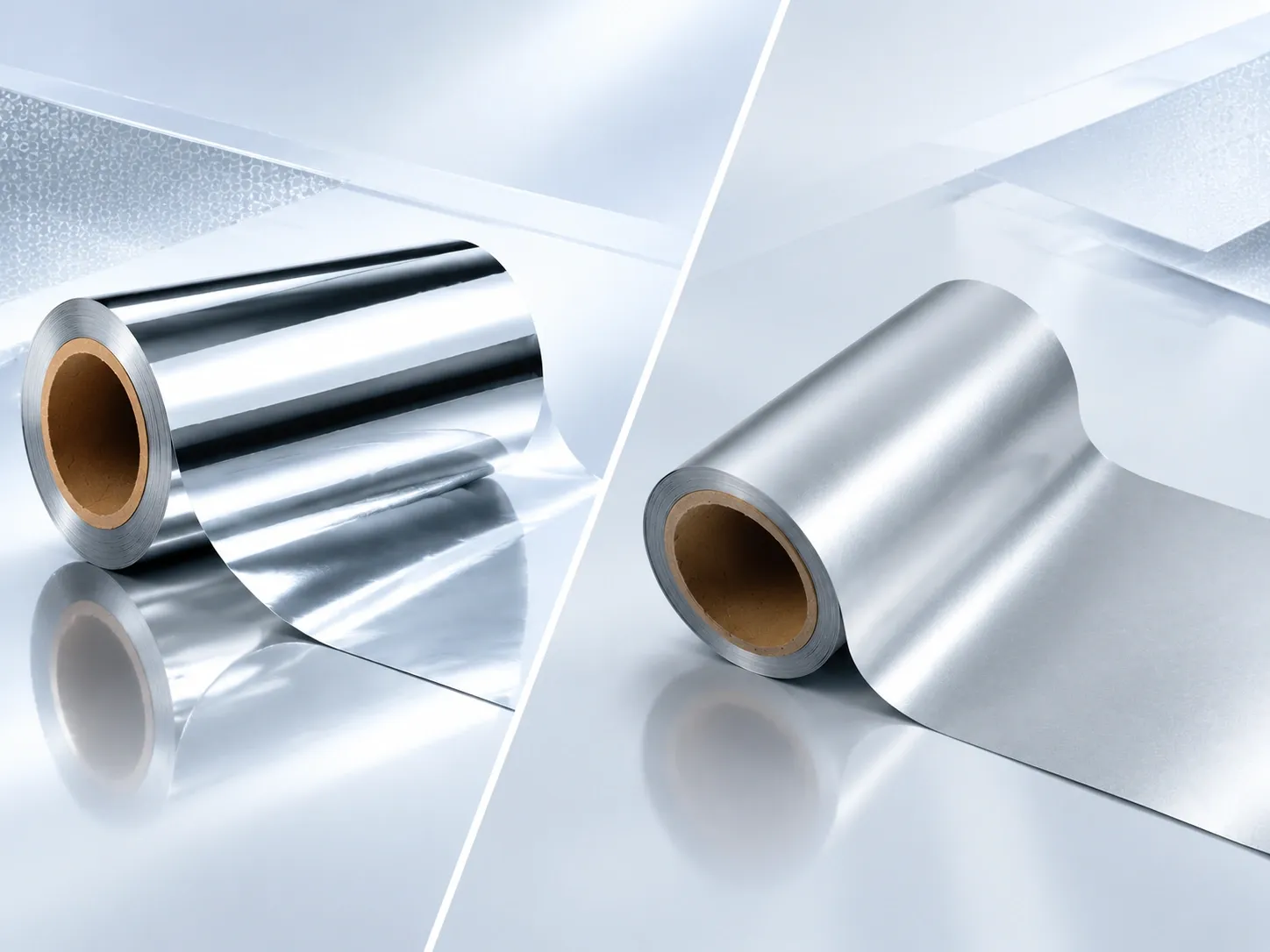 Compare metallized PET film and aluminum foil lamination on OTR/WVTR, cost, flex-cracking, chemical compatibility and recyclability — with a spec-based decision framework for industrial buyers.blog
Keep in touch with us
If you have any questions or needs about our products or services, please feel free to contact us at any time. We look forward to working with you and providing you with the best packaging solutions.
Mob:+86-15925678602
E-mail:info@pengyuangroup.com